Author Archive
A Sack Standoff in the Checkout Aisle
by ModernArts on Sep.26, 2011, under Green Shopping Bags, Shopping Bags
The plastic bags shoppers use to carry their goods home from the store have become an environmental battleground, and statistics are a key weapon in the fight.
Cities around the U.S. have banned or considered banning the bags because of their environmental impact. Manufacturers of the sacks have dueled with environmentalists and makers of reusable bags over carbon footprints. And last week, a maker of reusable bags settled a lawsuit filed by a plastic-bag manufacturer over competing numerical claims on bags’ imprint on the environment.
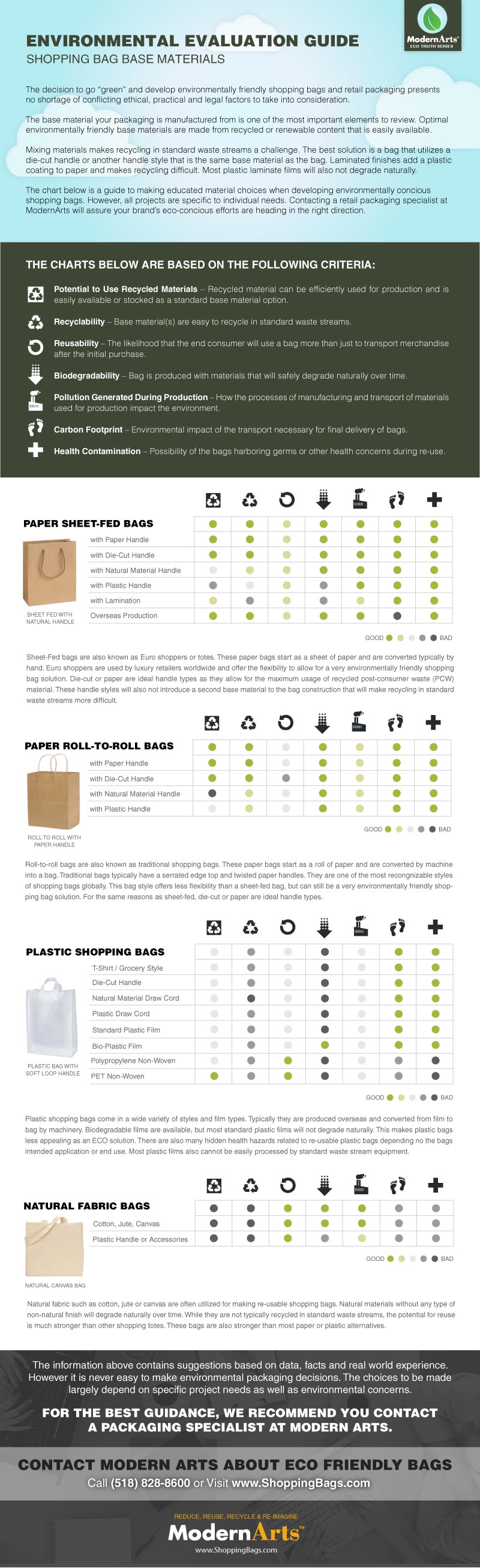
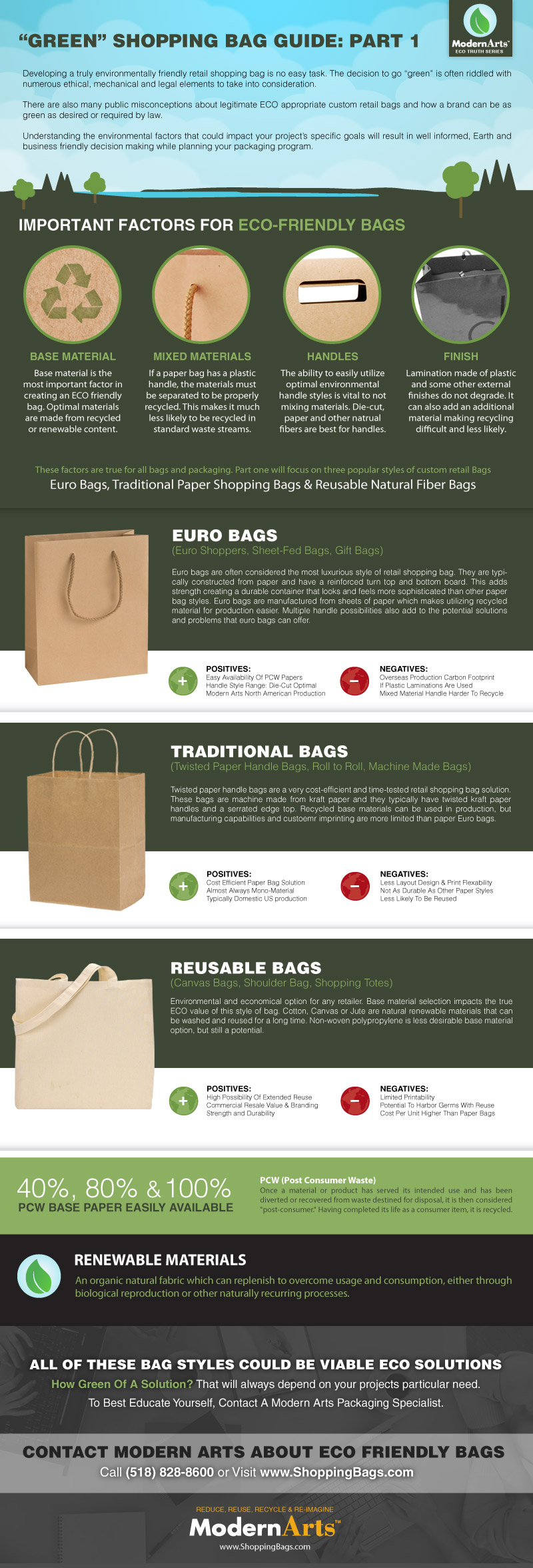
Reusable-bag makers, which market sacks made of sturdy canvas or recycled plastic meant for years or a lifetime of use, claim disposable plastic bags impose a big burden on the environment and deplete fossil fuels. Plastic-bag makers counter that a large proportion of their bags are reused or recycled, and that reusable bags must be washed frequently, diminishing their green credentials.
The lawsuit laid bare how much remains unknown about bags’ environmental impact. There is little information available on what proportion of plastic bags are reused or recycled, or on how many times a reusable bag must make the round trip to the store before it has earned the status of a net positive for the environment. And some frequently cited numbers in the debate are derived from studies funded by parties with a stake in the fight.
To support the contention that most store-provided plastic bags are reused, bag makers cite a 2007 survey funded by the American Chemistry Council, a trade group for chemical companies including plastic-bag makers. The survey found that 92% of respondents answered “yes” to the question, “Do you or does anyone in your household ever reuse plastic shopping bags?” But the survey didn’t distinguish between people who reuse a plastic bag once a year and people who reuse all their bags.
The answer matters because bags that get a second or third use—for instance, as trash-can liners—aren’t as big of a drag on the environment. Joseph Greene, a chemical engineer at California State University, Chico, figured that reusable bags must be used nine times before they begin to accrue environmental savings compared with plastic bags that aren’t reused.
Prof. Greene calculated that figure as a paid consultant for a report commissioned by reusable-bag maker ChicoBag Co., of Chico, Calif., the defendant in the recently settled lawsuit. Prof. Greene previously has consulted on behalf of plastic-bag makers.
The math comparing plastic and reusable bags changes if plastic bags are reused 40% of the time. That is the average figure reported by about 1,000 U.K. consumers in a 2005 survey. Then, reusable bags need to be used a minimum of 13 times to make them environmentally worthwhile compared with plastic bags, according to Prof. Greene. His report doesn’t account for the environmental cost of washing reusable bags.
Earlier this year, three plastic-bag manufacturers sued ChicoBag, claiming it included misleading statistics in its marketing materials. Last week one of the plaintiffs, Hartsville, S.C.-based Hilex Poly Co., and ChicoBag settled, with ChicoBag making an undisclosed payment and both sides agreeing to change which statistics they cite, and how. As part of the settlement, ChicoBag also agreed to tell visitors to its website that its bags must be washed when dirty, while Hilex agreed to provide more context to numbers it uses. The other lawsuits against ChicoBag were dropped.
“Consumers were misled because false statistics and false information were used” by ChicoBag, says Jennifer Mallory, an attorney representing Hilex in the case. “In this area of consumer advertising, it is very important that statistics and sources be correct.”
ChicoBag had at one point cited on its website the estimate that its bags begin to protect the environment once they have been used 11 times. The company attributed this to the Environmental Protection Agency’s website. The EPA took down the web page with that statistic after the agency’s New England regional office conducted “a periodic evaluation of the content for its accuracy,” according to an EPA spokeswoman. ChicoBag founder Andy Keller said Prof. Greene’s report, citing various published studies, backs up the number.
Another disputed number is the rate at which plastic bags are recycled. The main reason for the disagreements is that similar types of plastics are recycled together. While the total quantity of recycled plastic is measured, the EPA doesn’t distinguish between grocery bags and other plastic wrapping.
ChicoBag had stated on its website that 1% of plastic bags are recycled. That is from a 2005 EPA report. EPA statistics no longer separate plastic bags from similar plastic materials such as wraps for pallets. That category of packaging is recycled at a rate of 9.4%, according to an EPA spokeswoman. Hilex, the plaintiff that settled with ChicoBag, calculates a rate of 11.8% after removing some kinds of plastic material that it says aren’t recyclable, such as meat packaging. Both parties agreed to provide more context, including dates, when they cite statistics on recycling.
An EPA spokeswoman says calculating the recycling rate for plastic bags poses significant challenges: “Unlike with bottles and cans, bags are collected for recycling with other similar products”—including newspaper sleeves and dry-cleaning bags.”
Mr. Keller, the ChicoBag founder, says the numerical disputes tend to miss the bigger picture. “I think an accurate number is important,” Mr. Keller says. “In the meantime, we’re arguing over 1% or 12%. Both those numbers are anemic.”
—Learn more about this topic at WSJ.com/NumbersGuy. Email numbersguy@wsj.com.
New Synthetic Paper YUPO
by ModernArts on Feb.17, 2010, under Green Shopping Bags, Shopping Bags
100% waterproof, tear and stain resistant, prints beautifully, available in opaques and translucent. Ultra smooth Polypropylene makes incredibly strong and reusable shopping bags.
Environmental considerations:
No Ozone layer threatening emissions resulting from the manufacturing process. It is 100% recyclable and generates no detectable amounts of sulfur, chlorine, nitrogen or dioxide gas when properly incinerated.
Modern Arts and DuPont Partner on Tyvek Shopping Bags Project
by ModernArts on Aug.27, 2009, under Green Shopping Bags, Tyvek
Only now are we realizing the tremendous advantages of using Tyvek for shopping bags. Tyvek is considerably stronger than non-woven base material so it is much more “reusable” and has a much longer usable life. And Tyvek is washable in a way that non-wovens aren’t.
Tyvek can be printed in sophisticated designs and a full spectrum of colors.
So we at Modern Arts are teaming up with our partners at DuPont, and our colleagues at a manufacturing plant south of the border, to experiment with making Tyvek shopping bags in exciting shapes, new sizes and vibrant colors.
We’ll keep you posted on how it works out.
Mayor Bloomberg Wants a Plastic Bag Tax
by ModernArts on Aug.19, 2009, under Shopping Bags
Mayor Bloomberg Wants a Plastic Bag Tax
New York City’s Mayor Bloomberg wants to raise money to help offset the current financial crisis. He has proposed a 5 cent tax on every plastic bag, following in the footsteps of San Francisco and Seattle. New Yorkers use an estimated 1 billion plastic bags a year. The tax could raise an estimated 16 million dollars a year.
San Francisco bans plastic bags unless they are biodegradable, while a proposed 20-cent fee in Seattle is on hold pending a challenge. In Ireland, a 33-cent fee pushed plastic bag use down 94%.
New York considered a plastic bag tax earlier this year but settled for a mandatory recycling program, figuring most stores would just switch to paper, Councilman Peter Vallone Jr. (D-Queens) said.
Ikea tried charging customers a nickel per bag, but when demand for its 70 million bags a year dropped 92%, the chain just eliminated them.
“There’s a positive impact on the environment,” spokesman Joseph Roth said. “It certainly has not hindered our sales, and it has helped our reputation.”
Some grocery chains already give customers a discount for every cloth bag they bring. Whole Foods switched its stores to paper bags this year, even though the plastic industry insists paper bags are worse for the environment.
Virginia Considering Plastic Bag Ban
by ModernArts on Aug.19, 2009, under Shopping Bags
The Washington Post reported last week that the Virginia state legislature is considering a ban on plastic bags. Hoping to become more environmentally forward thinking, the state commented to the Post:
The ubiquitous bags are blamed for choking birds and fish, floating into trees, rooftops and streets and sticking around years longer than paper.
“We’re wasting energy. We’re polluting,” said Del. Adam P. Ebbin (D-Alexandria).
Virginia is not known for progressive environmental policy, but some lawmakers want to help the state find a place in the green movement.
One proposal would force stores to ban thin, single-use bags and allow only sturdy, reusable bags. Others would require stores to recycle plastic bags or charge customers a nickel for every bag the customers receive, and the money would go toward cleaning up the Chesapeake Bay.
The Reusable E-Bag
by ModernArts on Jul.26, 2009, under Shopping Bags
E BAG DESIGN
* Folded Pocket Size: 6″ x 6″
* Size: 6″w x 10″g x 16″ tall -bags suggested 1 size only
* Base Material: 75 gram PP Black non-woven
* Construction: Bottom gusset with two reinforcements and the bag has 2 pleats (of 3″ each) and a front and back – opens
* Handle: 5mm PP soft rope handle weaves in and out of entire top
The “E” Bag is the best designed reusable bag in the world! These facts about the “E” Bags were considered in its design:
1. For maximum reuse, bags must be easily carried and accessible.
2. The “E” Bag is designed to fold easily in a pocket or a purse.
3. The “E” Bag is light, yet very strong. Its patented design allows it to expand in to a large carrier, similar in size to a Jumbo shopping bag
4. Durability tests show that “E” Bags can be carried each day for over a year.
5. It can be carried in three ways: Over the shoulder, as a backpack or hand held
6. The bags are washable
7. “E” Bags are a great and valued promotional tool, a walking billboard in the form of reusable bags that keeps on walking!